

Toolbox Talk
Confined Spaces Toolbox Talk
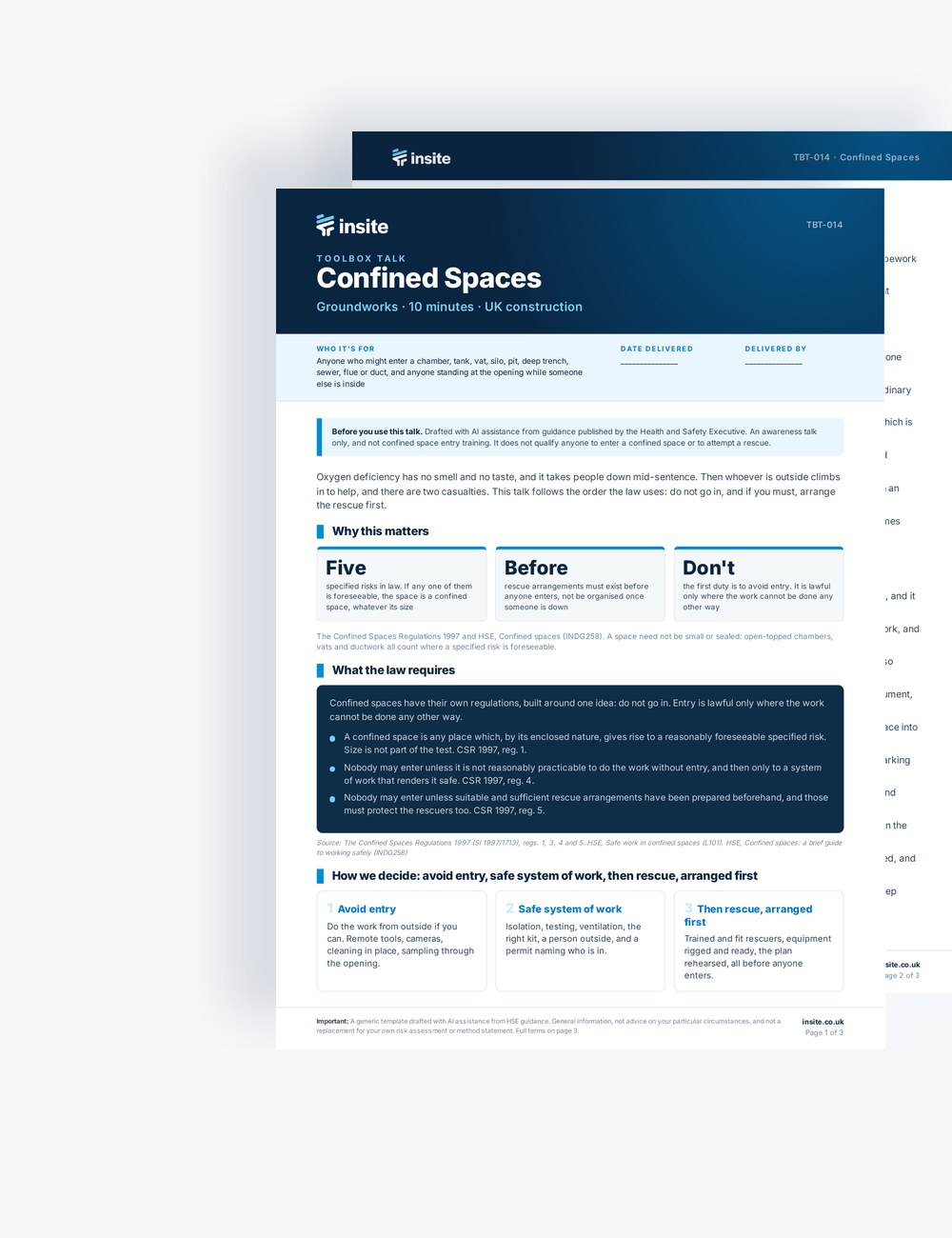
A free ten-minute awareness talk for UK construction sites, drafted from HSE guidance. An awareness talk only, not confined space entry training.
Need to record who attended? Download our free toolbox talk sign-in sheet, one page with 14 signature rows that works with any talk.
This is an awareness talk, not confined space entry training. Entry to a confined space needs task-specific training, a written safe system of work, and rescue arrangements in place beforehand. Nothing in this talk qualifies anyone to enter a confined space, to test an atmosphere, or to attempt a rescue.
Before you use this talk. Drafted with AI assistance from guidance published by the Health and Safety Executive. It is general information, not advice on your particular circumstances, and should not be relied upon as such. Adapt it to your site and your own risk assessment before use.
The atmosphere gives you no warning, and then it takes the rescuer too
Oxygen deficiency has no smell and no taste. There is no cough, no stinging eyes, no moment where you think you ought to get out. People go down mid-sentence, and the reason confined space incidents so often involve more than one casualty is that the person outside sees a colleague collapse and climbs in after them.
HSE is direct about this. Anyone attempting a rescue without the right training and equipment is themselves at serious risk of death or injury, and the regulations make the rescuer’s own safety part of the legal test rather than an afterthought. Rescuers have to be trained, fit enough for the task, immediately available, and protected from whatever caused the emergency in the first place.
A confined space is not defined by its size
This is the part people get wrong. The legal test is not how small the space is or whether it has a lid. It is whether, by virtue of its enclosed nature, there is a reasonably foreseeable specified risk. HSE’s own examples of less obvious confined spaces include open-topped chambers, vats, furnace combustion chambers, ductwork, and unventilated or poorly ventilated rooms. A deep manhole with the cover off is a confined space. So is a plant room where a refrigerant line could leak.
What the law requires
The Confined Spaces Regulations 1997 are built around one instruction: do not go in. Everything else in them is what you must do when going in genuinely cannot be avoided.
- The definition. A confined space is any place, including any chamber, tank, vat, silo, pit, trench, pipe, sewer, flue or well or other similar space, in which by virtue of its enclosed nature there arises a reasonably foreseeable specified risk. CSR 1997, reg. 1(2).
- Avoid entry. No person at work shall enter a confined space to carry out work for any purpose unless it is not reasonably practicable to achieve that purpose without such entry. CSR 1997, reg. 4(1).
- Then a safe system. Where entry cannot be avoided, no person shall enter or carry out work in the space otherwise than in accordance with a system of work which renders that work safe and without risks to health. CSR 1997, reg. 4(2).
- Rescue arranged first. Nobody shall enter or carry out work in a confined space unless suitable and sufficient arrangements for the rescue of persons in the event of an emergency have been prepared in respect of that space. CSR 1997, reg. 5(1).
The five specified risks
The definition hinges on the phrase “specified risk”, and the regulations list exactly five. If any one of them is reasonably foreseeable, you are working in a confined space in law:
- Serious injury to any person at work arising from a fire or explosion.
- Loss of consciousness of any person at work arising from an increase in body temperature.
- Loss of consciousness or asphyxiation of any person at work arising from gas, fume, vapour or the lack of oxygen.
- Drowning of any person at work arising from an increase in the level of a liquid.
- Asphyxiation of any person at work arising from a free flowing solid, or the inability to reach a respirable environment due to entrapment by a free flowing solid.
Regulation 5 goes further than simply requiring a plan. The arrangements are not suitable and sufficient unless they reduce the risks to the rescuers so far as is reasonably practicable, and unless resuscitation equipment is provided and maintained where the need for resuscitation is a likely consequence of one of those risks. And when the emergency happens, the arrangements must be put into operation immediately.
Source: The Confined Spaces Regulations 1997; HSE, Safe work in confined spaces (L101); HSE, Confined spaces: a brief guide to working safely (INDG258); HSE, Confined spaces legislation.
Where the danger actually comes from
- Oxygen deficiency. No smell, no taste, no warning. Oxygen gets used up by rust and by reactions in soil, or displaced by another gas, and a person can be unconscious before they know anything is wrong.
- Gas, fume and vapour. Sewers, contaminated ground, residues left in tanks, and gas seeping in through pipework or from work going on nearby.
- The work itself creating the hazard. Welding, cutting, solvents, paints, adhesives, and petrol or diesel plant running in or near the opening.
- Free-flowing solids. Grain, sand, powders and pellets. A crust can bridge over a void and collapse under someone’s weight, and it does not need to be deep to bury a person.
- Rising liquid. A chamber or sewer that fills after rain, or a valve opened by somebody who did not know anyone was inside.
- Fire and explosion. Flammable vapour in a small volume, or an oxygen-enriched atmosphere that makes ordinary materials burn fiercely.
- Heat. An enclosed space with no ventilation raises body temperature until someone loses consciousness, which is a specified risk in its own right.
- It does not look like a confined space. Open-topped chambers, vats, ductwork, combustion chambers and unventilated rooms all count where a specified risk is foreseeable.
- Getting a casualty out. An opening a fit person climbs through easily is a completely different problem with an unconscious body on the end of a line.
- The rescuer. The instinct is to go in. Untrained rescue without the right equipment is how one casualty becomes two, and the regulations make the rescuer’s own safety part of the test.
Controls to brief your crew on
- Do the work from outside if you possibly can. Avoiding entry is the first duty in law, not the cautious option, and it is the only control that removes the risk entirely.
- Nobody enters on a decision made at the hole. Entry needs a risk assessment, a written safe system of work, and on most sites a permit naming who is going in and for how long.
- Isolate it, then prove the isolation. Mechanical and electrical lock-off, pipework blanked or disconnected, so nothing can be introduced or started while somebody is inside.
- Test the atmosphere before entry and keep testing. Oxygen, flammables and toxics, on a calibrated instrument, by someone trained to use it. Conditions change while the work goes on, and one test at the top of a shaft says nothing about the air at the bottom.
- Ventilate. Mechanical ventilation where it is needed, and never oxygen to freshen the air, which turns the space into a fire risk.
- Right kit for the space. Breathing apparatus where the atmosphere cannot be made and kept safe, non-sparking tools, and low voltage or intrinsically safe lighting where flammables are possible.
- A person outside at all times. Someone who stays put, keeps count of who is in, holds the communication and raises the alarm. Not someone who steps away to do another job.
- Harness and line where it aids recovery, with the retrieval equipment rigged at the opening rather than sat in the van.
- Rescue arranged before entry. Trained and fit rescuers, resuscitation equipment to hand, the plan rehearsed, and the emergency services told what they would be attending.
- Nobody follows a casualty in unless trained and equipped for it. Raise the alarm, start the rescue plan, keep everyone else out. The urge to climb in is what kills the second person.
Source: HSE, Safe work in confined spaces (L101); HSE, Confined spaces: a brief guide to working safely (INDG258); CSR 1997, regs. 4 and 5.
Who is competent to do this work
- Confined space entry training is specific to the type of space and the work being done, and a toolbox talk is not a substitute for it. It covers the hazards, the equipment, the permit system and the emergency procedure.
- Whoever tests the atmosphere must be trained on the instrument, know its alarm levels and its limits, and understand that one test at the top of a shaft says nothing about the air at the bottom.
- The supervisor named on the permit must be competent to judge whether the isolation, the testing, the ventilation and the rescue arrangements are genuinely in place, and willing to refuse when they are not.
- Rescuers must be trained, fit enough for the task, present or immediately available, and capable of using the equipment provided. Regulation 5 makes reducing the risk to them part of the legal test.
Paperwork that should be in place
- The risk assessment identifying the specified risks and justifying why entry is necessary at all.
- A written safe system of work covering isolation, cleaning, testing, ventilation, access, equipment and communication.
- The permit to work, naming the space, the people, the supervisor, the time limit and the sign-off on the way out.
- Atmospheric test records, showing the instrument used, who tested and when.
- Calibration records for gas detectors, plus the function check done before use.
- The emergency and rescue plan, with training records for the rescuers and evidence the plan has been rehearsed.
Get the printable version. Free, no strings.
Three pages: the legal definition, the five specified risks, the avoid-entry duty, the rescue rule, discussion questions and space for site-specific notes.
Five questions to get the crew talking
- Is there any way to do this job without a single person going inside?
- Who is the person outside, and what happens when they need the toilet?
- If someone collapsed in there in the next ten minutes, who goes in, and with what?
- When was that gas detector last calibrated, and who function-tested it this morning?
- What could be turned on, opened or tipped into this space by someone who does not know we are in it?
How to run this toolbox talk
- Start with the avoid-entry question. Genuinely ask it, and be willing to change the method if someone has a good answer. That is the whole point of the first duty.
- Walk to the actual opening. Look at its size together and ask how a casualty would come back out through it.
- Name the person outside and the rescuers. Out loud, by name, so nobody assumes it is somebody else’s job.
- Check the detector in front of everyone. Calibration date and a function test, done where people can see it.
- Say the rescue rule plainly. Nobody follows a casualty in. Agree it before anyone is standing over an unconscious colleague.
- Pair it with the underground services toolbox talk, since chambers, sewers and deep trenches usually involve both.
- Record who attended on the free toolbox talk sign-in sheet.
Frequently asked questions
What counts as a confined space in UK law?
Any place, including a chamber, tank, vat, silo, pit, trench, pipe, sewer, flue or well or other similar space, in which by virtue of its enclosed nature there arises a reasonably foreseeable specified risk. Note what is absent from that test: size. A space can be large, or open at the top, and still be a confined space. HSE lists open-topped chambers, vats, ductwork, combustion chambers and poorly ventilated rooms as examples people commonly miss.
What are the five specified risks?
Serious injury from fire or explosion; loss of consciousness from an increase in body temperature; loss of consciousness or asphyxiation from gas, fume, vapour or lack of oxygen; drowning from a rising liquid level; and asphyxiation from a free flowing solid or entrapment by one. If any single one of these is reasonably foreseeable, the Confined Spaces Regulations 1997 apply.
Is a deep trench a confined space?
It can be. A trench is named in the regulations, but it only becomes a confined space when a specified risk is reasonably foreseeable in it, for example gas accumulating in the bottom, exhaust fumes collecting, or water rising. A shallow open trench in clean ground with good air movement generally is not. The judgement is about foreseeable risk, not depth, and it belongs in the risk assessment rather than in someone’s head at the edge of the hole.
Do you always need a permit to enter a confined space?
The regulations require a safe system of work rather than a permit specifically. HSE describes a permit-to-work as appropriate in many cases, and in practice it is how most sites demonstrate that the isolation, testing, ventilation, equipment and rescue arrangements were all confirmed before anyone went in. What the law does insist on is the safe system of work under regulation 4 and the rescue arrangements under regulation 5.
What must emergency arrangements include?
HSE lists communications, rescue and resuscitation equipment, trained and fit rescuers capable of using that equipment, procedures for shutting down adjacent plant, first aiders being available, and liaison with the local emergency services. Regulation 5 adds two legal tests: the arrangements must reduce the risk to the rescuers so far as is reasonably practicable, and resuscitation equipment must be provided and maintained where resuscitation is a likely need.
Should you go in to rescue a colleague who has collapsed?
Not unless you are one of the trained and equipped rescuers named in the plan. This is the hardest instruction in the talk and the most important one. HSE is explicit that people attempting rescue without proper training and equipment are themselves at serious risk of death or injury. Raise the alarm, put the rescue arrangements into operation, and keep everyone else out.
Can you use oxygen to improve the air in a confined space?
No. Never use oxygen to sweeten or freshen the atmosphere. An oxygen-enriched atmosphere makes materials that are normally difficult to ignite burn fiercely, and it is listed by HSE as a cause of fire and explosion risk in confined spaces. Use mechanical ventilation with air instead.
Check your inbox!
We've sent you an email with a download link to this free inspection template.
Free template download
Complete the form below to receive an email with a link to download this free template.
