

Toolbox Talk
Excavations Toolbox Talk
A free ten-minute safety briefing for UK construction sites, drafted from HSE guidance. Print it, deliver it at the workface, and record who was there.
Need to record who attended? Download our free toolbox talk sign-in sheet, one page with 14 signature rows that works with any talk.
Before you use this talk. Drafted with AI assistance from guidance published by the Health and Safety Executive. It is general information, not advice on your particular circumstances, and should not be relied upon as such. Adapt it to your site and your own risk assessment before use.
An excavation does not give you any warning
A trench that stood all morning can come in without a sound. There is no creak, no movement to step back from, and no second chance. HSE puts it plainly: no ground can be relied upon to stand unsupported in all circumstances, whatever it did yesterday and whatever it looks like now.
Depth is not the point either. A single cubic metre of soil weighs more than 1.5 tonnes, and it takes far less than that across your chest to stop you breathing. People have died in trenches they could see over the top of.
And the ground is not the only thing in the hole
Underneath most sites there is a live electricity cable, a gas main, a water main or all three. Electricity cables commonly sit between 450 mm and a metre down, gas mains around 750 mm under a road and 600 mm under a footway, with service connections shallower still. Those are typical depths, not promises, which is why locating comes before digging every single time.
What the law requires
Excavations get their own regulation in CDM 2015, and it is unusually direct. It is not enough to intend to support an excavation. The equipment has to be available before the work starts, not ordered once the sides start moving.
- Prevent collapse. Take all practicable steps to prevent danger from collapse or from material falling or dislodging, and have the support or battering available before anyone works in the excavation. CDM 2015, reg. 22.
- Stop things falling in. Take suitable precautions to stop people, plant and materials falling into the excavation, and to stop the edges being overloaded. CDM 2015, reg. 22.
- Inspect it, every shift. A competent person must inspect at the start of every shift, after any event likely to have affected strength or stability, and after any unintended fall of material. CDM 2015, reg. 22.
- Report it in writing. Where the inspection finds a problem, tell the person in control before the end of the shift and put the report in writing within 24 hours. Keep it on site until the work is finished, then for three months. CDM 2015, reg. 24.
The distances worth carrying in your head
- 500 mm is the margin to keep hand-held power tools outside of a marked service line
- 500 mm is also the closest a mechanical excavator goes to a gas pipe, and operators may require more
- Final exposure is by hand, digging horizontally, with insulated tools near cables
- 5 m is the distance to keep smoking and naked flames clear of a gas leak
Source: CDM 2015, regs. 19, 22, 24 and 25; HSE, Managing health and safety in construction (L153); HSE, Avoiding danger from underground services (HSG47).
How people get hurt in and around excavations
- Collapse. It happens in seconds and without noise. Ground that stood overnight can go after rain, after vibration, or after a machine tracks past.
- Buried electricity cables. Usually 450 mm to a metre down, but never assume. Black plastic sheathing should be treated as a live cable until the owner says otherwise.
- Gas. Mains around 750 mm under a road and 600 mm under a footway, connections shallower still. A struck plastic main fills a trench faster than people can climb out.
- Water and sewers. Generally 900 mm or deeper, and a burst main will flood and undermine an excavation in minutes.
- Falling in. People, plant and materials. Most edges get a barrier only after somebody has already walked backwards into the hole.
- Undermining what is next to you. Scaffold footings, foundations and garden walls with almost nothing under them. Digging alongside a structure can take its support away.
- Spoil and plant at the edge. Surcharge load is one of the commonest causes of a side coming in, and the spoil heap is usually the closest thing to the trench.
- Overhead lines. Tipping bodies and raised buckets do not need to touch a line for it to arc, and everyone near the machine is at risk.
- Bad air. Exhaust fumes, ground gases and heavier-than-air vapours collect in the bottom. A deep trench can behave like a confined space.
- Getting in and out. Climbing the trench sheets, jumping down, or a ladder that is neither secured nor long enough.
Controls to brief your crew on
- Plan, locate, dig, in that order. Get up to date service plans, then confirm them on the ground. Plans are a starting point, not a position: services move, snake, and go unrecorded.
- Use a locator properly. A cable avoidance tool with a signal generator, used by someone trained on it, checked and calibrated, and swept again as the dig progresses.
- Trial holes to prove it. Detection tells you something is there. Only a trial hole tells you what it is and how deep.
- Keep 500 mm clear. No mechanical excavator and no power tools within 500 mm of a marked service, and expose the last of it by hand, digging horizontally with insulated tools.
- Support on site before you dig. Trench box, sheets and props, or a battered slope decided in advance, and never a bit of both judged by eye on the day.
- Keep the load off the edge. Spoil, materials and plant set back, and stop blocks where vehicles tip or reverse towards the excavation.
- Barrier the edge properly. Guard rails and toeboards, or a trench box that stands proud of ground level so people cannot step in.
- A proper way in and out. A secured ladder of the right length, or steps, close enough that nobody is tempted to climb the sheets.
- Inspect every shift and write it down. Competent person, before work starts, after rain, after vibration, and after any fall of material.
- If you strike something, stop. With a cable, the operator stays in the cab, everyone else clears the area, and nobody enters until the owner makes it safe. With gas, evacuate, keep flames and smoking well clear, and call the national gas emergency line on 0800 111 999. Never attempt a repair, and never backfill before telling the owner.
Source: HSE, Excavations; HSE, Avoiding danger from underground services (HSG47); CDM 2015, regs. 22, 24 and 25.
Who is competent to do this work
- Whoever inspects the excavation must be competent to judge its stability, and must be the person who signs the report rather than someone repeating what they were told.
- Locator operators need training on the specific device and on its limitations, including how to use a signal generator, not just how to switch it on.
- The temporary works design for a support system is an engineer’s job, and the box or sheeting used on site must be the one designed for that ground and that depth.
- Machine operators and banksmen must be trained and authorised for the plant, including working near excavation edges and under overhead lines.
Paperwork that should be in place
- Service plans from every utility in the area, current, readable, and on site with the crew who are digging.
- Permit to dig where the site uses one, signed off against the locator sweep and the trial holes.
- Temporary works design and check for the support system, with the box or sheeting matched to it.
- Inspection reports, written within 24 hours where a problem is found, kept on site until the work is finished and then for three months.
- Calibration and check records for cable avoidance tools and signal generators.
- Training and authorisation records for inspectors, locator operators, machine operators and banksmen.
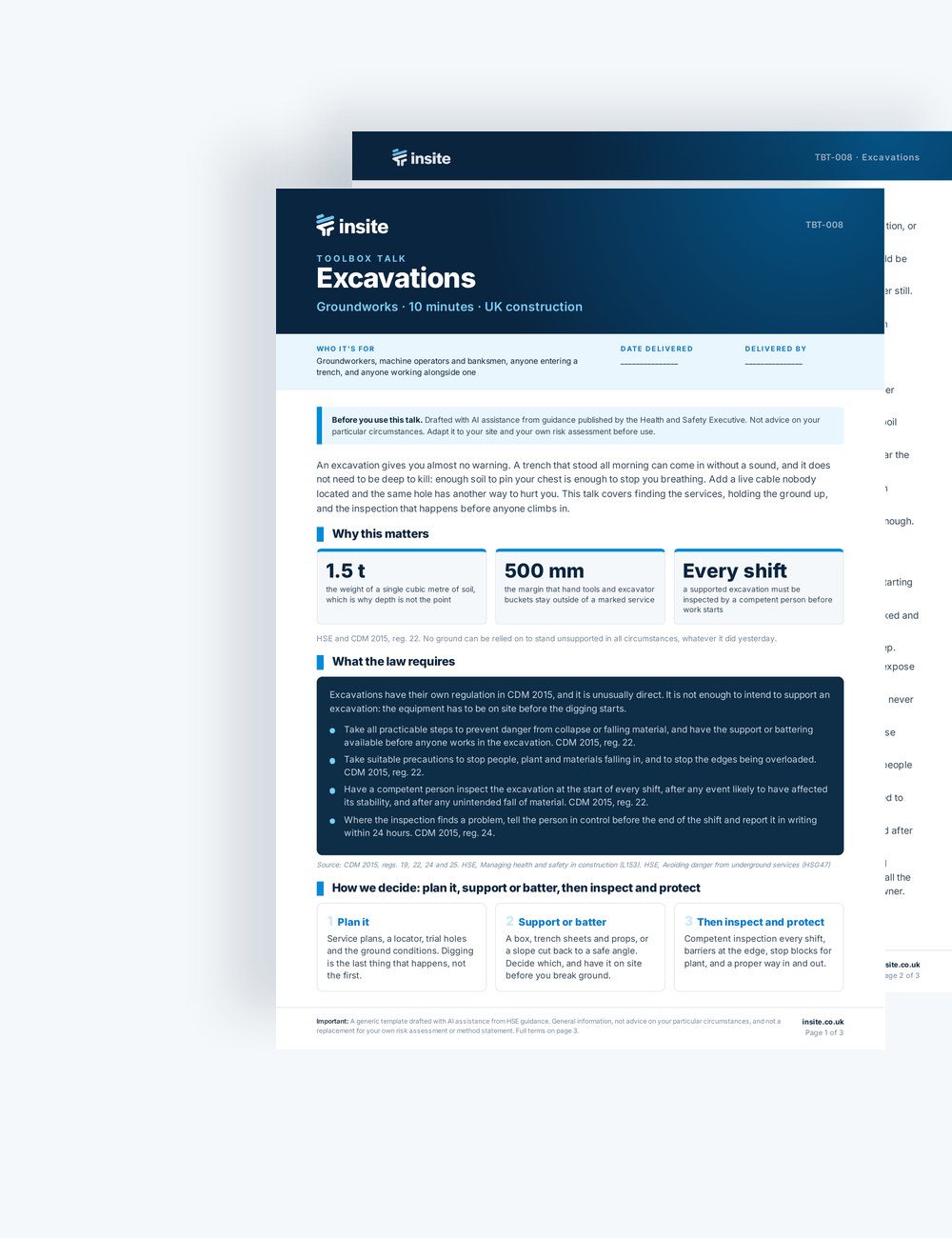
Get the printable version. Free, no strings.
Three pages: the law, the collapse risk, the services, the controls, discussion questions and space for site-specific notes.
Five questions to get the crew talking
- What services do we know are in this ground, and who swept it with the locator this morning?
- Is the support system on site now, or is it coming later in the week?
- Where is the spoil going, and how far back from the edge is that?
- Who inspected this excavation before the shift started, and where is the report?
- How do you get out of this trench in a hurry, and does that ladder reach?
How to run this toolbox talk
- Read it first and add your site detail: this ground, these services, this support system.
- Pick the moment. Start of shift, at the excavation, ten minutes maximum.
- Stand at the edge. Point at the spoil heap, the ladder and the barrier rather than describing them.
- Show the plans. Have the service drawings out, and be honest about what they do not show.
- Record who attended on the free toolbox talk sign-in sheet.
- Close the actions out, especially anything about edge protection or access.
Frequently asked questions
How deep does a trench have to be before it needs support?
There is no depth in the regulations below which support stops being necessary. CDM 2015 regulation 22 requires all practicable steps to prevent collapse, whatever the depth, and HSE is clear that no ground can be relied upon to stand unsupported in all circumstances. A cubic metre of soil weighs over 1.5 tonnes, and people have been killed in excavations they could see over.
How often must an excavation be inspected?
By a competent person at the start of every shift, after any event likely to have affected its strength or stability, such as heavy rain or vibration, and after any unintended fall of material. Where the inspection finds a problem, the person in control must be told before the end of the shift and a written report follows within 24 hours.
How close can an excavator dig to a buried service?
Not within 500 mm of the marked line of a service, and gas operators may require a greater distance depending on the pipeline. Hand-held power tools keep the same 500 mm margin. The final exposure of the service should be by hand, digging horizontally, using insulated tools near electricity cables.
Can you rely on utility plans to locate services?
No. Plans are a starting point only. They may not be to scale, services may have moved without the owner knowing, connections are often not marked, cables snake rather than run straight, and re-grading changes the depth. Plans, a locator used by a trained operator, and trial holes are all needed together.
What should you do if you hit a live cable?
If the machine strikes a cable, the operator stays in the cab. Everyone else keeps clear and nobody enters the excavation or approaches the machine until the cable owner has made it safe. Isolate and secure the area, and report it. Do not attempt to move the machine or inspect the damage yourself.
What should you do if you smell gas or damage a gas pipe?
Do not attempt a repair. Evacuate the immediate area, warn anyone in nearby buildings, keep smoking and naked flames at least 5 m clear, and call the National Gas Emergency line on 0800 111 999. Tell the service owner before anything is backfilled.
Check your inbox!
We've sent you an email with a download link to this free inspection template.
Free template download
Complete the form below to receive an email with a link to download this free template.
