

Toolbox Talk
Mobile Plant and Pedestrians Toolbox Talk
A free ten-minute talk for UK construction sites, drafted from HSE guidance. Segregation first, designing out reversing second, everything else after that.
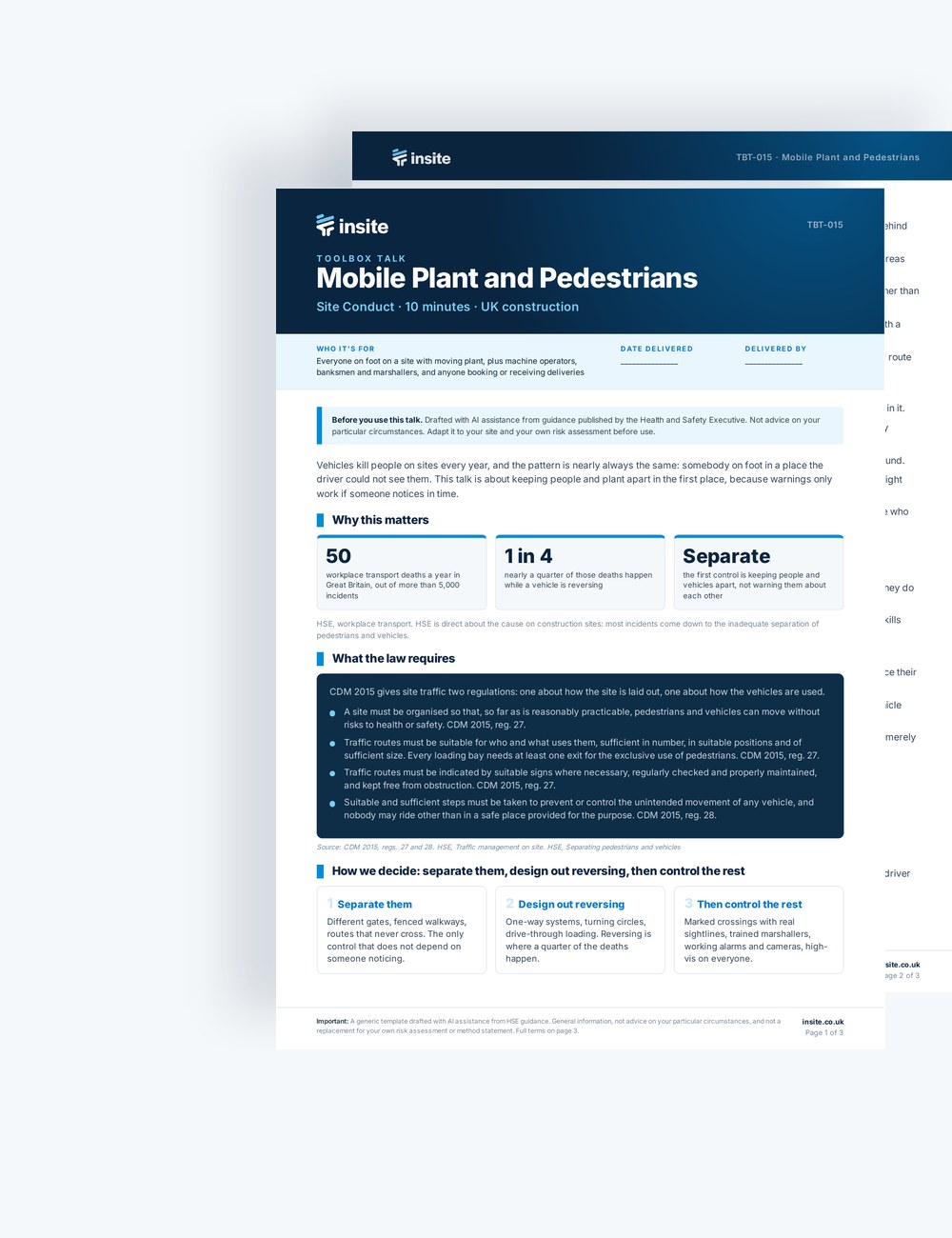
Need to record who attended? Download our free toolbox talk sign-in sheet, one page with 14 signature rows that works with any talk.
Before you use this talk. Drafted with AI assistance from guidance published by the Health and Safety Executive. It is general information, not advice on your particular circumstances, and should not be relied upon as such. Adapt it to your site and your own risk assessment before use.
The same accident, over and over
HSE puts it plainly: every year people die in the construction industry as a result of being struck by vehicles on site, and there are hundreds more preventable injuries. Across all industries there are over 5,000 workplace transport incidents a year in Great Britain, around 50 of them fatal.
What makes this worth ten minutes is how consistent the pattern is. HSE identifies the root cause as inadequate planning and control, and says the majority of incidents come down to one thing: the inadequate separation of pedestrians and vehicles. Not bad drivers. Not careless pedestrians. Layout.
Reversing is where the deaths cluster
HSE is specific about this too. Nearly a quarter of all deaths involving workplace transport happen during reversing. It is the manoeuvre where the driver has least visibility and the person on foot has most confidence they have been seen. Which is why the first question about reversing is not “how do we do it safely” but “can we lay the site out so it does not have to happen at all”.
What the law requires
CDM 2015 gives site traffic two regulations. Regulation 27 is about how the site is laid out. Regulation 28 is about how the vehicles are used. Between them they cover most of what goes wrong.
- Organise the site so both can move safely. A construction site must be organised in such a way that, so far as is reasonably practicable, pedestrians and vehicles can move without risks to health or safety. CDM 2015, reg. 27.
- Routes fit for who uses them. Traffic routes must be suitable for the persons or vehicles using them, sufficient in number, in suitable positions and of sufficient size. CDM 2015, reg. 27.
- A pedestrian-only exit from every loading bay. Loading bays must have at least one exit for the exclusive use of pedestrians. CDM 2015, reg. 27.
- Signed, checked, maintained and clear. Routes must be indicated by suitable signs where necessary for health or safety, regularly checked, properly maintained, and kept free from obstruction with sufficient clearance. CDM 2015, reg. 27.
- Control unintended movement. Suitable and sufficient steps must be taken to prevent or control the unintended movement of any vehicle, and measures must stop vehicles falling into an excavation or pit or into water, or overrunning an embankment. CDM 2015, reg. 28.
- Nobody rides where there is no safe place. A person riding on a vehicle must be in a safe place provided for that purpose, and must not remain on a vehicle during loading or unloading unless given a safe place of work. CDM 2015, reg. 28.
The general duty behind it
HSE frames the underlying rule simply: by law, pedestrians and vehicles must be able to use a traffic route without causing danger to the health or safety of people working near it. That is the test to apply when you look at a gate, a crossing or a corner and wonder whether it is good enough.
Source: The Construction (Design and Management) Regulations 2015; HSE, Traffic management on site; HSE, Separating pedestrians and vehicles; HSE, Reversing; HSE, Introduction to workplace transport safety.
Where the danger actually comes from
- Reversing. Nearly a quarter of workplace transport deaths. The driver cannot see behind, and the person behind assumes they have been seen.
- Blind spots. Excavators, dumpers and telehandlers all have areas the driver simply cannot see, and those areas move as the machine slews or the boom rises.
- Slewing. The counterweight on a 360 excavator sweeps a full circle. People get caught by the tail swing rather than the bucket.
- Shared gateways. One gate for vehicles and people puts the two together at the worst possible moment, with a driver turning in off a live road.
- Crossing on foot. Unmarked crossings, no sightlines, and the short cut everyone takes because the proper route is longer.
- Loading and unloading. People stood beside a load that is still moving, or on a bed that has started to tip.
- Unintended movement. Plant left running, not braked, not chocked, parked on a slope, or with the keys still in it.
- Edges, excavations and water. Vehicles overrunning an edge because there are no stop blocks and nobody banking them.
- Riding on plant. Standing on forks, riding in a bucket, sitting on a load, because it is quicker than walking round.
- Poor light and noise. Early starts, winter afternoons, and ear defenders that remove the one warning that might have worked.
- Deliveries arriving unannounced. A wagon that turns up without a booking finds its own way in, past people who were not expecting it.
Controls to brief your crew on
- Separate people from vehicles. Different entrances, fenced or barriered walkways, and routes laid out so they do not cross. Everything else on this list is second best.
- Design out reversing. One-way systems, turning circles and drive-through loading, so the manoeuvre that kills people does not need to happen.
- Every loading bay gets a pedestrian-only exit. That is a legal requirement under reg 27, not a nicety.
- Mark the crossings where routes must meet, put them where the sightlines are genuinely good, and enforce their use rather than hoping.
- Use trained marshallers properly. Agreed signals, visible to the driver at all times, standing clear of the vehicle path, in high-vis. If the marshaller loses sight of the vehicle, the vehicle stops.
- Keep everyone else out of the reversing area. People who do not need to be there should be well clear, not merely alert.
- Reversing aids in working order. Mirrors, CCTV, alarms and sensing systems, checked as part of the daily inspection rather than assumed.
- Stop blocks and edge protection wherever plant tips or reverses towards an excavation, an edge or water.
- Nobody rides who is not in a seat provided for it. No forks, no buckets, no standing on the bed.
- Secure plant when it is left. Brake on, attachments grounded, keys out, chocked on a slope. Preventing unintended movement is a named duty.
- Book deliveries in. Planned arrival times, a named person to receive them, and the route briefed before the driver comes through the gate.
Source: HSE, Separating pedestrians and vehicles; HSE, Reversing; HSE, Traffic management on site; CDM 2015, regs. 27 and 28.
Who is competent to do this work
- Plant operators must be trained and certificated for the specific machine and authorised on this site, not simply experienced on a different one.
- Marshallers and banksmen need training in the task, the agreed signal set and where to stand. HSE describes them as appointed to control manoeuvres and trained in the task. It is a role, not a spare pair of hands.
- Whoever writes the traffic management plan must understand this site’s deliveries and pinch points, and how both change as the job progresses.
- Visiting drivers must be told the layout and the site rules before they drive in. HSE specifically calls this out, because they are the ones who do not know where people walk.
Paperwork that should be in place
- The traffic management plan, current for this phase of the job rather than the one drawn at tender.
- Site induction records covering the routes, the crossings and the rules, including for visiting drivers.
- Operator training and authorisation records for every machine in use on site.
- Marshaller training records and the agreed signal set.
- Daily plant inspection records, including mirrors, cameras and reversing alarms.
- Delivery bookings, so vehicle movements are planned rather than arriving unannounced.
Get the printable version. Free, no strings.
Three pages: the law, the segregation hierarchy, reversing, marshalling, discussion questions and space for site-specific notes.
Five questions to get the crew talking
- Where do people and plant cross on this site today, and is that crossing marked?
- Which vehicle here has to reverse the most, and could we design that out?
- Can you name the blind spots on the machine you work next to?
- Who is marshalling the delivery this afternoon, and what signals are you using?
- Did every reversing alarm and camera actually get checked this morning?
How to run this toolbox talk
- Do it outside, on the route. Stand at the gate or the crossing you are talking about. This is a layout talk, and layout is easier to see than to describe.
- Get an operator to show the blind spots. Sit someone in the cab and have the crew walk round until they disappear from view. It lands harder than any diagram.
- Pick one reversing manoeuvre and try to remove it. Ask the crew how the site would have to change. Sometimes the answer is cheap and nobody had asked.
- Name today’s marshaller and agree the signals out loud, so nobody improvises at the moment it matters.
- Pair it with the excavations toolbox talk where plant is working near open ground.
- Record who attended on the free toolbox talk sign-in sheet.
Frequently asked questions
What does the law say about separating pedestrians and vehicles on site?
CDM 2015 regulation 27 requires a construction site to be organised so that, so far as is reasonably practicable, pedestrians and vehicles can move without risks to health or safety. It also requires traffic routes to be suitable and sufficient, and every loading bay to have at least one exit for the exclusive use of pedestrians. HSE summarises the underlying duty as: pedestrians or vehicles must be able to use a traffic route without causing danger to the health or safety of people working near it.
How many people are killed by workplace transport each year?
HSE reports over 5,000 workplace transport incidents a year in Great Britain, around 50 of which are fatal. In construction specifically, HSE says people die every year from being struck by vehicles on site, alongside hundreds of preventable injuries.
What proportion of workplace transport deaths involve reversing?
Nearly a quarter. HSE states that almost one in four deaths involving workplace transport occurs during reversing, plus many more incidents that cause costly damage without injuring anyone. That is why the recommended first step is removing the need to reverse through one-way systems and drive-through loading positions, rather than managing the reversing better.
What should a banksman or marshaller do?
Use a clear, agreed signalling system; stay visible to the driver at all times; stand in a safe position outside the vehicle’s path; wear high-visibility clothing; and stop the manoeuvre immediately on losing sight of the vehicle. They should be appointed to the role and trained in it. Everyone who does not need to be in the reversing area should be kept well clear.
Do you need separate gates for vehicles and pedestrians?
HSE recommends providing separate entry and exit gateways for pedestrians and vehicles, and separate doors with vision panels where routes pass through buildings. Where full separation is not achievable, the fallback is clearly marked and protected crossing points positioned where visibility is best, with their use enforced rather than left to judgement.
What counts as adequate segregation?
HSE sets out a hierarchy. Complete segregation first: entirely separate roadways and footpaths, footbridges or subways. Then keeping pedestrians out of vehicle work areas unless they need to be there. Then barriers, clear route markings and raised kerbs at entrances, exits and corners. Warning systems and high-visibility clothing sit below all of that, because they only work if someone notices in time.
Can someone ride on the forks or in the bucket for a short distance?
No. CDM 2015 regulation 28 requires anyone riding on a vehicle to be in a safe place provided for that purpose, and prohibits remaining on a vehicle during loading or unloading unless a safe place of work is provided. Forks, buckets and load beds are not safe places provided for carrying people, however short the distance.
Check your inbox!
We've sent you an email with a download link to this free inspection template.
Free template download
Complete the form below to receive an email with a link to download this free template.
