

Toolbox Talk
Lone Working Toolbox Talk
A free ten-minute talk for UK construction sites, drafted from HSE guidance. Working alone does not add a hazard, it removes the person who would have helped.
Need to record who attended? Download our free toolbox talk sign-in sheet, one page with 14 signature rows that works with any talk.
Before you use this talk. Drafted with AI assistance from guidance published by the Health and Safety Executive. It is general information, not advice on your particular circumstances, and should not be relied upon as such. Adapt it to your site and your own risk assessment before use.
Lone working does not add a hazard. It removes the person who would have helped
This is the whole idea, and it is worth saying out loud at the start of the talk. HSE puts it plainly: lone workers face the same workplace hazards as anyone else, but the risk of those hazards causing harm is greater because there may be nobody to help or support them if something goes wrong.
So the controls look different from most talks. There is not much to say about the hazard itself. Almost everything useful is about contact: who knows where this person is, when they are expected to make contact, who notices if they do not, and what that person then does.
It covers more people than most sites think
HSE defines a lone worker as someone who works by themselves without close or direct supervision. That takes in the obvious cases and a lot of less obvious ones: people alone at a fixed base, anyone working outside normal hours, homeworkers, and anyone working away from a base, including maintenance and repair staff, delivery and HGV drivers, and service engineers. Volunteers and gig-economy workers on short or on-demand contracts are covered too.
What the law requires
There is no Lone Working Act, and people sometimes take that to mean there is no duty. The duty is in the general risk assessment, and HSE is specific about where lone working belongs inside it.
- Assess the risk. Every employer must make a suitable and sufficient assessment of the risks to the health and safety of employees at work, and to anyone not in their employment arising out of the work. MHSWR 1999, reg. 3(1).
- Record it at five or more. Where an employer employs five or more employees, the significant findings must be recorded, along with any group of employees identified as being especially at risk. MHSWR 1999, reg. 3(6).
- Review it. The assessment must be reviewed where there is reason to suspect it is no longer valid, or where there has been a significant change, and any changes made. MHSWR 1999, reg. 3(3).
- No separate lone worker assessment is required, but HSE is explicit that lone working risks must be covered in the general assessment rather than left out of it. HSE, INDG73.
The work HSE says needs a second person
This is the part worth knowing before anyone is sent out on their own. HSE names tasks where the risk assessment is likely to require at least one other person present:
- Work in confined spaces, where a supervisor and a dedicated rescuer may both be needed.
- Work on or near exposed live electrical conductors.
- Diving operations.
- Transporting explosives.
- Fumigation work.
Set that limit in writing, before the pressure of a Friday afternoon makes it negotiable. The confined spaces talk covers the first one in detail, including why the rescue arrangements have to exist before anyone enters.
Source: The Management of Health and Safety at Work Regulations 1999; HSE, Protecting lone workers (INDG73); HSE, Lone working: protect those working alone; HSE, Violence at work: assessing the risks.
Where the danger actually comes from
- Nobody comes. The hazard is the same as it always was. What is missing is the person who would have seen it happen and raised the alarm.
- Work that should never be done alone. HSE names confined space entry, work near exposed live conductors, diving, transporting explosives and fumigation.
- Illness, not just injury. A cardiac event, a diabetic episode, or a fall off a stepladder, with nobody else in the building.
- Violence and aggression. Higher where work is late or early, in isolated places, or involves authority over the public, cash, or people affected by drink or drugs.
- Entering someone else’s premises. No control over the layout, the occupants, the dog, or the way back out.
- Contact that fails where they are. No signal in a basement, a plant room, a lift shaft or halfway up a hill.
- Driving. Often the biggest risk a lone worker faces, and the one least likely to appear in the assessment.
- Nobody expecting them. The job overruns, the phone dies, and nobody notices until the next morning.
- Out of hours. First aiders, fire marshals, supervision and everyone who knows the building have all gone home.
- Isolation and stress. HSE is clear that lone working affects mental health, and that poor support from managers is a key factor.
- New or vulnerable workers. Trainees, young workers, pregnant workers, and anyone unfamiliar with the task or the place.
Controls to brief your crew on
- Decide what cannot be done alone, and write it down. Confined spaces, live electrical work, and anything else your assessment names. A limit nobody can quietly ignore.
- Put lone working in the risk assessment, not in a separate document nobody reads. With five or more employees, the significant findings get recorded.
- Agree the contact arrangement before they go. Intervals, method, and a named person who is expecting to hear from them.
- Check the method works where they are going. A phone with no signal in the plant room is not a control.
- Have a robust return check. Confirmed back to base or back home, with somebody who notices when that confirmation does not arrive.
- Agree what happens when contact is missed. Who calls, after how long, who goes to look, and who holds the keys and the address.
- Test it. HSE expects alarm devices and emergency procedures to be tested regularly, not assumed to work.
- Match supervision to the risk. HSE’s rule of thumb is that the higher the risk, the greater the level of supervision required. New workers and trainees may need accompanying at first.
- Train for being on your own. Personal safety and conflict resolution where violence is foreseeable, and first aid including self-treatment where the assessment calls for it.
- Train for the on-the-spot call. Dynamic risk assessment means deciding to withdraw when the job is not what was briefed. HSE is clear it does not replace the written assessment.
- Keep in touch with the person, not just the paperwork. HSE identifies direct contact with a manager as what protects against isolation and stress.
Source: HSE, Protecting lone workers (INDG73); HSE, Violence at work: assessing the risks; MHSWR 1999, reg. 3.
Who is competent to do this work
- Lone workers need more training, not less. HSE makes the point that training matters more where supervision is limited, because a lone worker cannot simply ask a colleague. They must be competent in the task and able to recognise when to stop and seek advice.
- Whoever sets the lone working arrangement must be competent to judge whether the task can safely be done alone at all, and willing to say that it cannot.
- Anyone relying on dynamic risk assessment must be trained in it, with controls available to them and support afterwards.
- Managers must know the arrangement they are responsible for, including the escalation steps and who to call out of hours.
Paperwork that should be in place
- The risk assessment with lone working covered inside it, and the significant findings recorded where there are five or more staff.
- The lone working arrangement, naming contact intervals, the method, the person expecting contact, and where the worker will be.
- The escalation procedure for missed contact, with names, timings and out of hours numbers.
- Records of testing the alarm devices, apps or call systems, and the emergency procedure.
- Training records covering the task, personal safety, conflict resolution and first aid where relevant.
Get the printable version. Free, no strings.
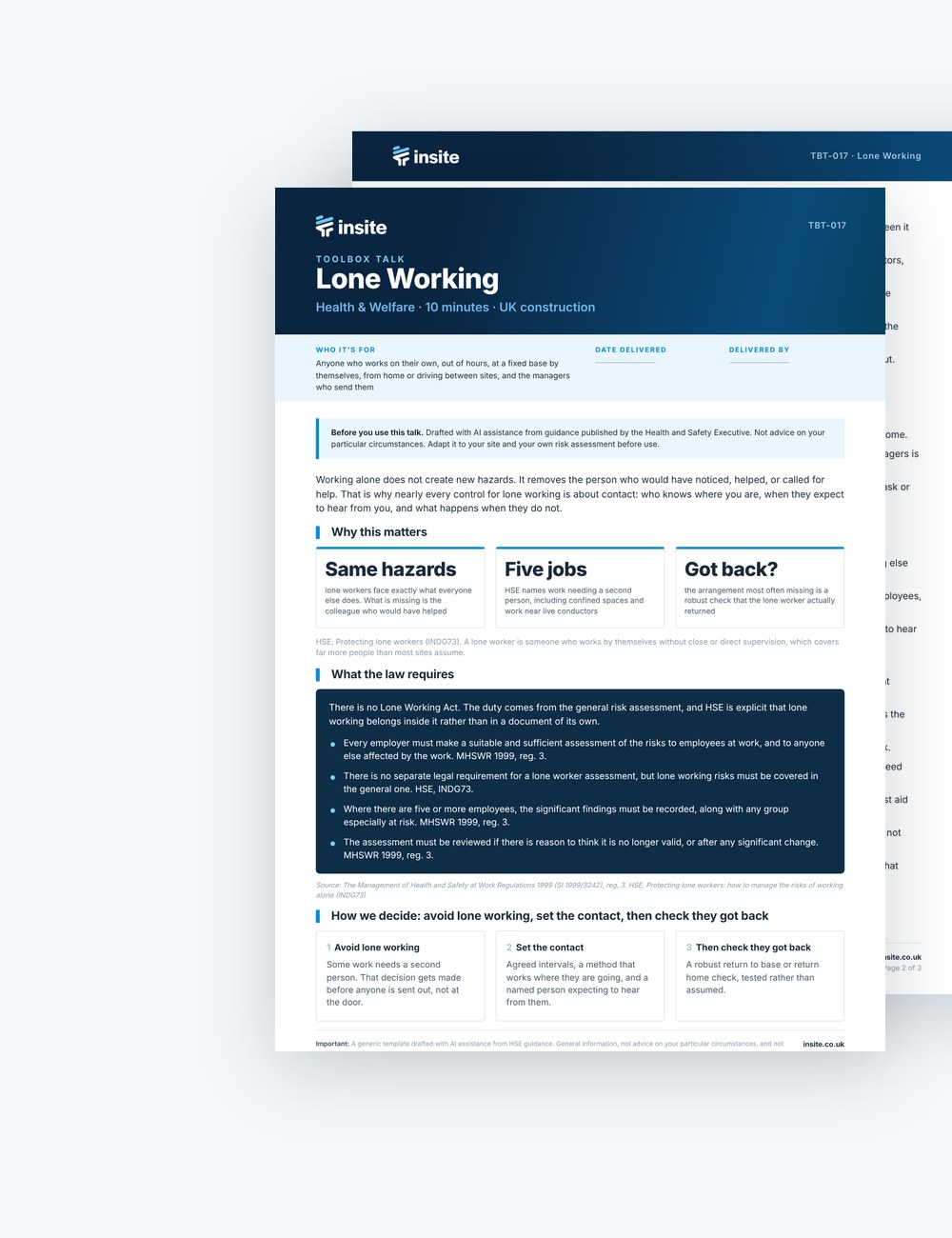
Three pages: the law, the work that needs a second person, the contact and escalation rules, discussion questions and space for site-specific notes.
Five questions to get the crew talking
- Who is working alone this week, and does anybody know where they will be?
- If you stopped answering your phone at four o’clock, how long before someone noticed?
- Is there anywhere on this job where your phone has no signal?
- What would make you walk away from a job and call it in?
- Who confirms you got home, and what happens if that confirmation never comes?
How to run this toolbox talk
- Start with the four o’clock question. Ask it cold and let the silence do the work. Most crews find the honest answer is “tomorrow morning”.
- Name the person who is expecting contact. Out loud, by name. An arrangement with no named person is not an arrangement.
- Test a phone in the worst spot on site. The basement, the plant room, the lift shaft. Five minutes of evidence beats any policy.
- Agree the missed-contact rule there and then. How long, who calls, who drives out, who has the address.
- Ask what would make them withdraw. People need explicit permission to walk away before they will use it.
- Pair it with the confined spaces toolbox talk, since that is the clearest case of work nobody should do alone.
- Record who attended on the free toolbox talk sign-in sheet.
Frequently asked questions
What counts as a lone worker?
HSE defines a lone worker as someone who works by themselves without close or direct supervision. That includes people alone at a fixed base such as a shop, petrol station, factory or warehouse; people working separately or outside normal hours, such as security staff, cleaners and maintenance crews; homeworkers; and people working away from a base, including construction and repair staff, delivery and HGV drivers, couriers, and service representatives. Volunteers and gig-economy workers are covered too.
Is lone working illegal?
No. There is no general prohibition on working alone, and no Lone Working Act. What the law requires is that the risks are assessed and controlled under regulation 3 of the Management of Health and Safety at Work Regulations 1999, and that the employer is satisfied the work can be done safely by one person. For some tasks the honest answer to that question is no.
Do you need a separate lone working risk assessment?
Not as a legal requirement. HSE is explicit that there is no separate duty to produce a lone-worker-specific assessment, but that lone working risks must be covered within the general risk assessment. In practice a short lone working section inside the main assessment, naming the contact arrangement and the escalation steps, is more useful than a standalone document nobody opens.
What work should never be done alone?
HSE names tasks where the assessment is likely to require at least one other person: work in confined spaces, which may need both a supervisor and a dedicated rescuer; work on or near exposed live electrical conductors; diving operations; transporting explosives; and fumigation work. Your own assessment may add to that list, and whatever is on it should be written down rather than left to judgement on the day.
How often should you check in with a lone worker?
HSE does not set an interval, because the right one depends on the risk. What it does expect is a monitoring system that is embedded and clearly understood: agreed intervals of contact by phone, radio or similar, supervisors visiting periodically where the risk justifies it, and a robust system to confirm the worker has returned to base or home at the end of the job. Whatever interval you pick, the test is whether someone would notice within it.
What should happen if a lone worker misses a check-in?
The guidance does not prescribe a single procedure, so this is one you have to write. It needs four things: how long after a missed contact you act, who makes the call, who physically goes to look, and who holds the address and the keys. HSE does expect emergency procedures to set out how and when lone workers contact their employer, and for the technical solutions and procedures to be tested regularly rather than assumed to work.
Does lone working affect mental health?
Yes, and HSE’s updated guidance addresses it directly. Lone working can increase work-related stress and affect mental health, with poor support from managers and colleagues identified as a key factor. Poor contact can leave people feeling disconnected or abandoned. Employers must assess work-related mental health risks and reduce them so far as reasonably practicable, and may need to make reasonable adjustments, including under the Equality Act 2010. Direct contact with a manager is what HSE highlights as protective.
Check your inbox!
We've sent you an email with a download link to this free inspection template.
Free template download
Complete the form below to receive an email with a link to download this free template.
